Showing posts with label Allotment Photography. Show all posts

Monday, 28 June 2010

Community kitchen gardening and the National Gardens Scheme Open Day

With the hot weather, growing, watering, preparations for the Open Day and only a few weeks left of my daughter's first year of school - we've been run off our feet and I'm just catching up with the posting of some Open Day pictures. All in all it was a successful day. Our allotments association tells me we raised £750 on the gate which goes to the National Gardens Scheme - Claire House raised £450 on refreshments and said it was 'one of their best events yet' and the plant stall raised £250 which our allotment society keeps and which will be used for projects and improvements around the colony.

Readers will know by now - this is "Questioner's Garden Time" - I'm not in the business of spin - so this post includes some comments on where we've been and how far we have yet to go in terms of developing community gardening (an organic community gardening) in our area.

Our site must be one of the largest urban sites in the U.K. Our plot is turning into a bit of a show plot for organic gardening on site. It really is very pretty now. We found ourselves on the main thoroughfare on the Open Day and welcomed hundreds of visitors, including our Lord Mayor Councillor Neil Ritchie. I spent at least ten minutes talking to the Mayor and the First Lady about how we had converted our allotment plot organically from derelict four years ago. I'd tied some photographs to one of our apple trees along with some blog posts from this blog. I don't have a photograph of the Lord Mayor as he wanted to take a photograph with his own camera and the dignitories seemed to be enjoying themselves so much on the day I didn't like to intrude too much.

Perhaps the message is finally getting through to Cheshire West and Chester Council that community gardening is something that is particularly important for the welfare of citizens on the ground.

We've had some good news about the Council having completed a site visit in preparation for the installation of our composting toilet. The site is large - regular plot holders cope with squatting-in-a-shed-with-a-bucket on a day-to-day basis but if we are to hold public events like this we need better facilities.

In my conversation with the Lord Mayor I stressed the benefits of gardening organically - especially for families with children - (i.e it changes their eating habits for the better), pointing out that we were enjoying our plot that day with three generations of family.


However, there are still pressing issues that need to be tackled. There are lots of issues which create extra work and make life more difficult for plot holder families with disabilities like us. (There are no wheel-chair friendly plots on site and access is often a challenge for people).

 Before the Mayor left I made sure I also pointed out the derelict plot right next door to our half-plot.


This was the view from our half plot to the plot right beside it. Readers may recall this plot has been in this state for more than a year now. (See this blog post from last year's Open Day). There are around a dozen other plots elsewhere on our site like this and I've lost count of the number of conversations I've had with other plot holders about possible reasons why the plots are allowed to fall into disrepair like this. I explained to the Lord Mayor that having a plot like this next door to you - undermines your efforts to keep your own in good order - simply because you are constantly confronted with weed seeds that are blown over to your own plot. (If you have to manage fatigue as part of managing a disability then that's a serious issue).

Lack of maintenance on this plot has also undermined my efforts to garden organically. The plot and the paths are so overgrown that a neighbour has sprayed them with pesticides in desperation. I'm aware that my compost heaps are just next door to this path.

I'm still not sure what the problem is here - when  a plot-holder has difficulty keeping up their plot - perhaps due to a disability or family circumstance - are the Council too slow to offer assistance? We have a waiting list now, and theoretically there shouldn't be any vacant plots - but there still seem to be plots in disrepair.

Put yourself in the shoes of someone who is looking for a plot - if you were offered the one in the picture, would YOU take it? I mean our plot looked like that and I single-handedly converted it from derelict, but I don't think there are many people will the skills (or the bout of madness) that was necessary to  even attempt this. Surely the Council should be making it much easier for people to grow their own? 

So all in all - it's nice to be featured on the National Gardens Scheme programme as an demonstration organic plot, but despite the hard work, the fun we had and the money raised for good causes - the Open Day doesn't seem to have changed very much about the day-to-day problems we have on the ground.   

I'm going to close with some good news. As most of us did - our bee man worked very hard talking to Open Day visitors on site. I'm very happy to say that due to the presence of his three hives, yields of soft and tree fruit and vegetables have increased in the last year. Here are some more pictures of the hives, the cage he has constructed for them, the flowers he planted around the cages and the lovely posters he put up for Open Day.


And two pictures of the hives:


Sunday, 18 April 2010

What's growing in the kitchen garden now?

Time is short. People often think they don't have enough to maintain a kitchen garden. This week I had just twenty minutes to spare. So I picked rhubarb and a little asparagus and shot these pictures hastily. An overview of what's happening on the plot. We're about three weeks late with Spring this year. Generally (and without having attended a permaculture training course - I've adopted many permaculture principles. Many of them are just sensible and helpful for people who don't have much time, or people who have physicial challanges. I don't dig, some people like it - but no-dig gardeners have been having success with this approach for years now and we do too.

Long awaited daffodills and an apple tree (around fifty years old) - one of two inherited from previous plot holders. I pruned it heavily in previous years and it still fruits well. It's our plot-and-a-half's fourth birthday in June. We converted it from derelict. (And I mean derelict). I shot these pictures with an automatic, compact camera - the colour is a bit iffy, but for documentative purposes they've presentable. Hope you like them.


The Peach Tree. Variety Avalon Pride. In the third year and just about to burst into bloom. I think we've missed the frost now, thank goodness.


Comfrey. An essential ingredient of any organic garden. I harvest it three times a year, wilt it and use it as a compost activator. I'm pleased to say that we haven't burned any of our green waste in four years. Composting is much faster with comfrey and it can also be used as a plant food or a mulch. Although soaking it in water is too much faff for me and it smells terrible. You can also feed it to rabbits (in small amounts) and chickens.

The picture above on the right is a Cherry Plum. I keep them small and they provide a good wind break. It's flowering for the first time in it's third year.
Garlic made it through the severe winter - whereas the autumn sown onions didn't. They usually do very well, so I've planted red onions instead, along with lots of spring onions and winter hardy spring onions.


Raspberries. I've treated all these as if they were autumn fruiting i.e. cut them down to the ground in the autumn. here they are coming up again. It's quite dry at the moment, of course the sunshine is lovely but we do need some rain. I hardly every water anything unless it is newly planted. Luckily we have clay soil which looks dry on top but the this type of soil holds a lot of water and so just underneath the surface it is actually quite moist.

The next picture shows our second bed of raspberries which were planted in autumn.

The plant in the picture on the right is an important one. Poached Egg Plant. I sowed a few in early spring last year and they've survived the winter brilliantly. Of course they're fantastic for pollinators like bumble bees and the hoverflies like them too. And they're very low-maintenance plants. They self-seed. If you've got too many, they are easy to pull up and put on the compost heap.

Blackcurrant bushes. (Seem to have mislaid this picture). Three of them in all. One is quite small at the moment. I'm using the destructive pruning method as mentioned in the Encyclopedia of Organic Gardening. That means instead of pruning individual branches you cut all branches down on one in three of your bushes each year. So you still have two fruiting ones. This saves time and the blackcurrants seem to respond well.


Two rhubarb plants, looking healthy. We'll be able to pick some this year. They were planted the autumn before last.

Rosemary. This one is for the bees really. It is usually the first bush to flower.
This is our pear tree in it's third year now. Can't remember the variety (always write it down!) but I do remember it's September-fruiting.

In this air-brushed media world of ours - I feel social realism is important! We need to think about what didn't work as well as our successes! These broad beans were a victim of the poor weather we've had. I planted them in root trainers at the usual time and they didn't germinate well in our courtyard. Then the frost got them and they lost their tops. The good news is, that in year four of our clay soil allotment we've improved the soil so much with the compost we've made and the rabbit manure we added - that we can now sow more things directly. Less work I hope.

You can only just about see these, but on the right here the asparagus is coming up now. It's been a long wait. We can't harvest much this year, but they're delicious!


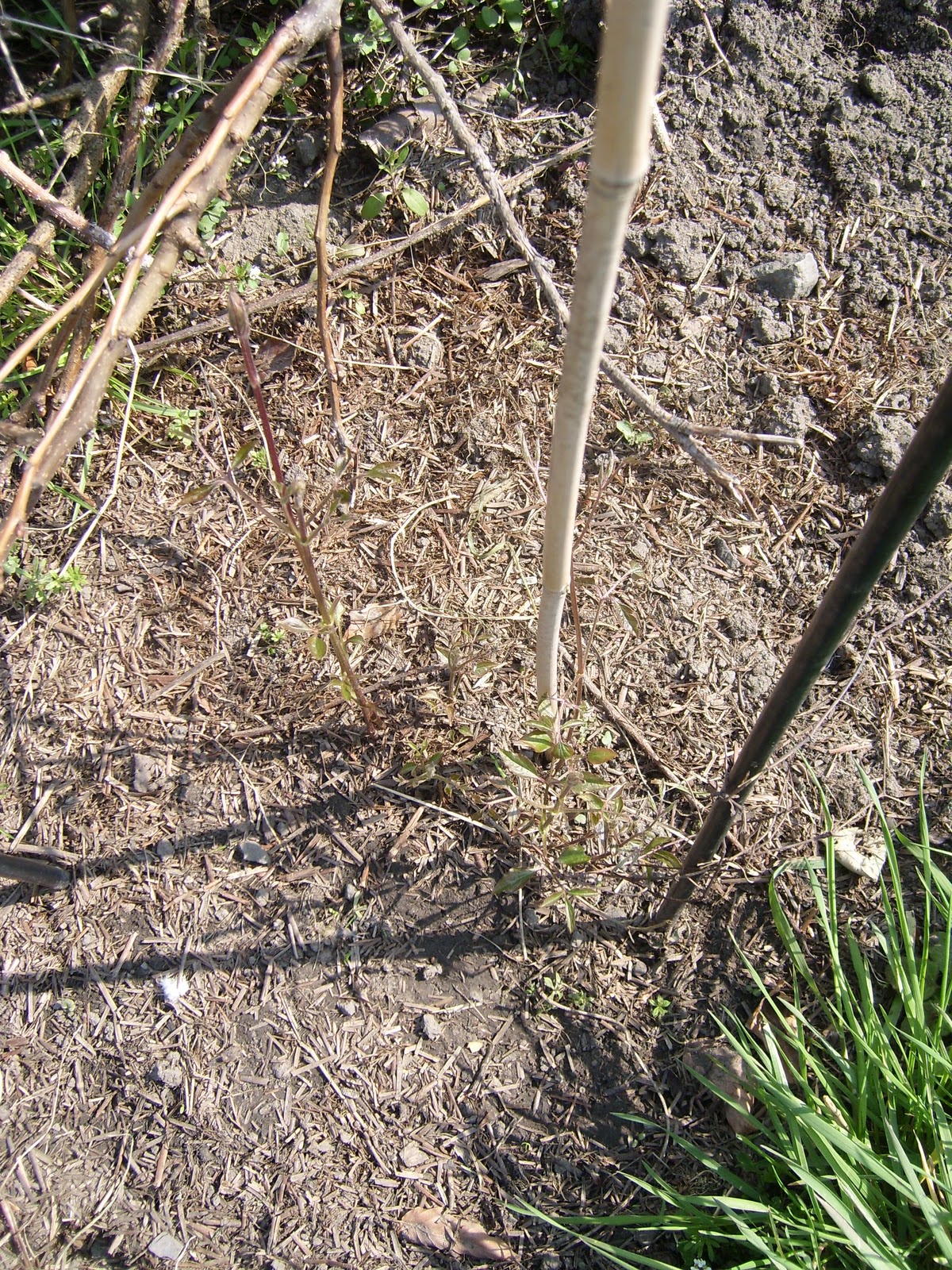
Very happy to see that this clematis my mother gave me made it through the winter
Some Little Gem lettuces I planted out. We could do with some rain.

Tuesday, 27 October 2009

Allotment Photography

Looking at
perfectly executed gardening photos - I often tend to feel I'll never measure up. I'm sure novice gardeners share that feeling too. So here are photographs of a different - dare I say more realistic kind.

It's not necessarily vital that your your veg patch looks professional and pretty at all times is it? Of course it's a bonus if it does, and a beautiful layout comes with time and experience.


But most organic allotmenteers just want things to work. It's a different aesthetic isn't it? First in the series of (definitely not airbrushed) less-than-perfect-looking-but-very-productive-fruit-and-veg-patch-photographs are the leeks. We haven't started harvesting these yet but we have many more than last year. So that's great. The leeks in this picture could have done with more rain and/or watering. I could have got them started earlier too.


We do have larger ones on the plot. These specimens in the next picture (on the right) are nearly ready to harvest.

The asparagus patch is one of our greatest gardening achievements so far. This is a not-particularly-impressive picture. Practically speaking, the plants are really healthy and sound. For the first time (in June next year) we'll be looking forward to harvesting organically grown asparagus spears. In this picture you might think the couch grass at the side is encroaching on the raised bed, but actually I dug a small trench to keep it away which is very effective as the couch grass doesn't cross it.

My mother told me that my grandfather (who had several allotments) hardly even used to water his. I try to adopt the same approach. Otherwise it is way too much work for us. I've got used to planting just before it rains and nurturing the soil so that it retains water for a long time. I also make extensive use of mulches. Which brings me to our next picture:

Not exactly neat and tidy but very effective on the scale of things as well as being ecologically sound. Here is a slightly raised simple bed edged with cardboard boxes (from mail order goods) and topped with wood chippings from our communal heap on the allotment site The advantage of this technique is it gives the worms a place to hide out (underneath the cardboard) and escape the winter chills.

I planted dwarf broad beans in this space at the weekend. Bare rooted raspberries went in next door to these. More onions and garlic can wait until November.

Last but not least the strawberries. These are recently transplanted - they didn't do so well in the old water butt where they were before as it was difficult to provide them with enough water.

They're looking a bit tatty - but as you can see they're fruiting in October - I'll give them a bit of TLC and they'll be in good shape for next year.

Really glad to say that I won't be buying any more organic slug pellets. Our froglets must have done very well and I saw a juvenile in early autumn - so hoping they'll do the slug patrol for us next year. It's great to see so many spiders and ground beetles too.