Where did that familiar expression come from: "There's no point in doing something - unless you tell people what you're doing"?
It's an expression which is so important for many of us who are involved with organic gardening initiatives and community gardening on so many levels. You might be an allotment holder who wants to pass on some useful knowledge to a neighbour. You might be a community organisation - large or small - who wants to know how to write a decent press release. However you set about telling people what you're doing - you want to communicate in the best way you can.
My own intensive involvement in organic gardening began a mere five years ago. I wondered why - of all the things I had done in my life - that I didn't have practical gardening skills. When my daughter was born, I began to ask my parents more questions about their parents and I realised that both my mother and my father's family had had allotments.
My father's family had a grand total of three allotments. Every day after school he would go to the allotment site to tend these plots - including the livestock they had - (a goat and lots of rabbits). For them it really was a matter of subsistence. As a boy my father hated doing it and vowed he would never push his own children into fruit and vegetable growing.
So my parents encouraged me on the academic side of things instead- and I didn't come to practical gardening until much later in life. Of course I'd connected up the issues. I worked for Greenpeace Germany's North Sea campaign in my twenties - and as part of the Toxics Team we had a Water Campaign which led a huge initiative to convert every school canteen to organic food. They were really successful - and that was way before Jamie Oliver came along. I'm talking the 1980s here!
The urge to food production coincided too with the birth of my first child. I'm not going to romanticise breast feeding. It can be really hard work. Although it can also make many things a lot easier - nothing to carry if you go travelling - no bottles to wash and usually fewer childhood illnesses. It was the first time I had been solely responsible for another very small human being. And in the case of food production - I was very clearly physically responsible. Your body works very hard then - I couldn't go for one hour without having a snack or a pint glass of water (or two). The summer of 2005 was very, very hot.
I made a direct connection between myself as a human being and the earth then. I'm not romanticising this either, I hope. But the connection was there. The term 'Mother Earth' is often used as an insult in this society - and I heard it myself when I was breastfeeding (someone said to me "but it's okay, you're not the Mother Earth type..."). And that's true - somehow I'm not. I wonder why you never hear the expression "Father Earth"?
Why am I writing this here? Well, where I'm standing just now in my life - I'm faced with lots of important questions - like - how do I communicate some, all, or any of this to a new generation? I'm confronted with this every day as my daughter is just four and a half.
I hope you like this new template. It seems more fitting for Spring. Over the past four and a half years since I became a journalist (and organic gardener) - I've tried to sharpen up my skills. I'd like to do this writing/blogging/photography thing better. And I'd like to be a more efficient and effective gardener.
One of my photographs earned substantial praise from experienced photographers at Shutterpoint recently. Let me know what you think. To see it follow this link:
Shutterpoint. Frances Laing
The contrived tree rends a healthy workload
Showing posts with label food democracy. Show all posts
Showing posts with label food democracy. Show all posts
Friday, 26 March 2010


Tuesday, 23 March 2010
Quaker Winter Gathering
 This weekend brought a change from sowing and planting:
"Living adventurously" - the Quaker Winter Gathering weekend in Bala, North Wales.
I took a series of photographs on Sunday morning, including this one. It was a great weekend, especially for the young people and the children. A big thank you to all the children's helpers and the organising committee.
There were quite a few conversations going on around growing, sowing, bee-keeping and allotments. I touched base with Lisa Mundle and Jonathan Garratt from Bangor who've set up a new training intiative called http://www.foodskillsforall.co.uk/
The site will be of interest to all those working with schools to encourage organic growing. Good to see you again, Lisa and Jonathan.
Sunday, 24 January 2010
BBC City Food Lecture
Listen to Chief Scientist David King at the City Food Lecture on BBC Radio 4 at this link:
"It's predicted that the world population will reach nine billion in 2050. Simon Parkes reports from the City Food Lecture, where former Chief Scientist Sir David King spells out his vision for how we can meet that challenge".
"It's predicted that the world population will reach nine billion in 2050. Simon Parkes reports from the City Food Lecture, where former Chief Scientist Sir David King spells out his vision for how we can meet that challenge".
Sunday, 10 January 2010
Wednesday, 28 October 2009
Gardeners have the power - Crush Hunger!
Couldn't let today pass without putting in a wee plug for Kitchen Gardener's International new initiative 'CRUSH HUNGER'. If enough people donate $10 dollars each they will be in line for a prize of $50,000 to be used to help more people globally grow their own fruit and vegtables. Tell your friends! Check out this link for more details: http://crushhunger.org/
KGI has done some brilliant work on the 'Eat the View' campaign and succeeded in getting a veg patch on the Whitehouse lawn. (I'm told Buckingham Palace held secret meetings with the first Lady. They say that was what prompted our monarch to follow suit...). Gardeners have the power...
KGI has done some brilliant work on the 'Eat the View' campaign and succeeded in getting a veg patch on the Whitehouse lawn. (I'm told Buckingham Palace held secret meetings with the first Lady. They say that was what prompted our monarch to follow suit...). Gardeners have the power...
Friday, 16 October 2009
World Food Day - Crunching the Numbers about Food
Received an email from Roger Doiron over at Kitchen Gardener's International with some interesting stats in time for World Food Day tomorrow. He's allowing bloggers to republish them so here we go. (Normally I find numbers a bit scary, but these, I'm sure you will agree are important and enlightening). Thanks Roger.
1: number of new kitchen gardens planted at the White House this year AP
1943: the last time food was grown at the White House White House
20 million: the number of new gardens planted in 1943 LA Times
40%: percentage of nation's produce coming from gardens in 1943 LA Times
7 million: estimated number of new food gardens planted in the US in 2009 NGA
$2000: amount of savings possible per year from a 40' x 40' garden KGI
90%: percentage of fruit/vegetable varieties lost in the US the last 100 years CNN
3500: number of vegetable varieties owned by Monsanto Monsanto
18,467: number of new small farms counted in the last agricultural census USDA
4,685: number of farmers markets nationwide USDA
4,100: number of Wal-mart stores and clubs in the US Wal-mart
187,000 ft2 : average area of a Wal-mart superstore Wal-mart
60,112 ft2: average area of a farmers' market USDA
9.5 million: number of imported food shipments arriving in the US each year Huffington Post
226,377: number of establishments registered to export food to the US Huffington Post
200: number of on-site inspections of these establishments conducted by the FDA last year Huffington Post
76 million: number of people who fall ill each year due to food poisoning CDC
50 gallons: volume of sugared beverages consumed per person in the US each year LA Times
22,727: number of Olympic-sized swimming pools those beverages would fill Answers.com
$15 billion: annual estimated revenue of a penny-per-ounce tax on soda LA Times
$20.5 billion: Coca-Cola's gross profit in 2008 Coca-Cola
72 million: number of American adults considered obese CDC
33%: percentage of US children likely to develop obesity or Type 2 diabetes CDC
10-15 years: average number of years their lives will be shortened as a result CDC
57 years: average age of the American farmer USDA
25 days: average shelf-life of a Twinkie Snopes
350 parts per million: sustainable level of CO2 in atmosphere 350.org
390 parts per million: current level of CO2 in the atmosphere NOAA
31%: percentage of human-caused greenhouse gas emissions attributable to food and agriculture IPCC
2020: year by which many geologists feel the world will have reached "peak oil" production UK Research Centre
10 calories: average amount of fossil fuel energy required to produce 1 calorie of food energy in industrialized food systems Cornell
29,100 calories: estimated fossil fuel calories required to produce one order of Outback Steakhouse Aussie Cheese Fries Men's Health
1 billion: number of hungry people in the world in 2009 FAO
9.1 billion: projected world population in the year 2050 US Census
70%: percentage increase in global food production required to feed that projected population FAO
70%: percentage of world's fresh water used for agricultural purposes UNESCO
1.8 billion: number of people expected to experience "water scarcity" in the year 2025 UNEP
0: number of new, oil-rich, water-rich, fertile and inhabitable planets we are likely to discover in the next 40 years
1: number of people needed to make a positive difference in any of the above: you!
1: number of new kitchen gardens planted at the White House this year AP
1943: the last time food was grown at the White House White House
20 million: the number of new gardens planted in 1943 LA Times
40%: percentage of nation's produce coming from gardens in 1943 LA Times
7 million: estimated number of new food gardens planted in the US in 2009 NGA
$2000: amount of savings possible per year from a 40' x 40' garden KGI
90%: percentage of fruit/vegetable varieties lost in the US the last 100 years CNN
3500: number of vegetable varieties owned by Monsanto Monsanto
18,467: number of new small farms counted in the last agricultural census USDA
4,685: number of farmers markets nationwide USDA
4,100: number of Wal-mart stores and clubs in the US Wal-mart
187,000 ft2 : average area of a Wal-mart superstore Wal-mart
60,112 ft2: average area of a farmers' market USDA
9.5 million: number of imported food shipments arriving in the US each year Huffington Post
226,377: number of establishments registered to export food to the US Huffington Post
200: number of on-site inspections of these establishments conducted by the FDA last year Huffington Post
76 million: number of people who fall ill each year due to food poisoning CDC
50 gallons: volume of sugared beverages consumed per person in the US each year LA Times
22,727: number of Olympic-sized swimming pools those beverages would fill Answers.com
$15 billion: annual estimated revenue of a penny-per-ounce tax on soda LA Times
$20.5 billion: Coca-Cola's gross profit in 2008 Coca-Cola
72 million: number of American adults considered obese CDC
33%: percentage of US children likely to develop obesity or Type 2 diabetes CDC
10-15 years: average number of years their lives will be shortened as a result CDC
57 years: average age of the American farmer USDA
25 days: average shelf-life of a Twinkie Snopes
350 parts per million: sustainable level of CO2 in atmosphere 350.org
390 parts per million: current level of CO2 in the atmosphere NOAA
31%: percentage of human-caused greenhouse gas emissions attributable to food and agriculture IPCC
2020: year by which many geologists feel the world will have reached "peak oil" production UK Research Centre
10 calories: average amount of fossil fuel energy required to produce 1 calorie of food energy in industrialized food systems Cornell
29,100 calories: estimated fossil fuel calories required to produce one order of Outback Steakhouse Aussie Cheese Fries Men's Health
1 billion: number of hungry people in the world in 2009 FAO
9.1 billion: projected world population in the year 2050 US Census
70%: percentage increase in global food production required to feed that projected population FAO
70%: percentage of world's fresh water used for agricultural purposes UNESCO
1.8 billion: number of people expected to experience "water scarcity" in the year 2025 UNEP
0: number of new, oil-rich, water-rich, fertile and inhabitable planets we are likely to discover in the next 40 years
1: number of people needed to make a positive difference in any of the above: you!
Sunday, 13 September 2009
Battle for composting toilet on site rages on
There has been some controversy about our site's plan to build a composting toilet (just one!). Our site is one of the largest in the U.K., I believe.
One brave Liberal Democrat councillor I talked to has agreed to donate £500 of his expenses allowance to support the plan. In a street surgery he told me that some other councillors refused to support the project saying it was 'too political'. (Obviously there is a revolutionary plot behind the idea isn't there?) No seriously, given the diversity of social standing of our plot holders - we've got everyone from people with flash cars and huge gardens at home to people on the breadline - I can't think of anything which would be less political - and if you ask me, the phrase 'it's too political' is just a poor excuse to do nothing.
On the ground, as an organic gardener - I'm well aware we have less than basic facilities which don't appear to be anywhere near the national standards or best practice seen on other allotment sites.
Dozens of plots are off the mains altogether. Watering is often a problem for this reason - as organic gardeners we mulch a great deal, according to Organic guidelines to save water - but at present we have one small corporation water butt between thirty-odd plot holders - no stand pipe - and this butt is often unusable - in hot weather the water pressure is non-existent and you turn up at the plot with a few hours to spare only to find there is no water because the butt isn't refilling fast enough. Many of us have installed extra butts to collect water from our sheds, but the situation still represents a difficulty for anyone with any sort of health challenge as all this often means carrying water for quite a distance.
Our lack of basic facilities also affects our ability to reach out to the community. One fellow parent remarked in exasperation one day: "They ought to try toilet training a toddler on a site with no hand-washing facilities - a mile or more from the nearest loo..." I couldn't agree more.
So much for local and national government rhetoric about healthy living and encouraging people (and children) to take more exercise and eat more fruit and veg. Much of it seems to be nothing more than lip-service.
We have disabilities in the family - and whilst if you are able-bodied, squatting behind the shed or over a bucket may be an ( adventurous) option - for anyone with a disability - it presents problems. When we have an Open Day, or visitors to the site - I lose visitors. As soon as they find out the toilets are so far away, many with 'toileting challenges' have to head for home.
It's time our Council shifted their priorities and started to understand the true meaning of the word 'sustainable development' . They've just spent £15 million odd on new headquarters for themselves which allow them to sup champagne whilst overlooking the racecourse in comfort. See this link: Still - what can you expect - it's only a few years since they they tried to sell our site off to build a tennis court....plot holders have got long memories, thank goodness.
Attitudes to people with disabilities could do with a shake-up too. After attempting a discussion about disability rights with a council representative on Friday I was told that 'disabled people' needed plots 'near the road'. I had to point out the Equal Opportunities basics here: that not everyone has a disability you can see for starters - (what about mental health issues?) - and not everyone is in a wheelchair(so access requirements are different).
Finally - surely what we should be aiming towards is empowering people - not shunting them off in some sort of car park ghetto. We have no intention of moving to be 'near the road' - when we've put in sustained effort to convert our plot from derelict for the past four years and are just beginning to reap the benefits.
So - readers of this blog - who WOULD like to learn more about the benefits of composting toilets and recognise their advantages in terms of saving costs - and water - I'm enclosing this link - there is a wealth of information out there if you search for 'Composting Toilets' but this link is good to start - click here.
AND dear readers - don't log off without signing our petition please! You don't need to put your postal address down, and you can click the options to hide your email address too, if you wish. Thanks very much fellow plotters - we really appreciate your help. Sign the petition here.
One brave Liberal Democrat councillor I talked to has agreed to donate £500 of his expenses allowance to support the plan. In a street surgery he told me that some other councillors refused to support the project saying it was 'too political'. (Obviously there is a revolutionary plot behind the idea isn't there?) No seriously, given the diversity of social standing of our plot holders - we've got everyone from people with flash cars and huge gardens at home to people on the breadline - I can't think of anything which would be less political - and if you ask me, the phrase 'it's too political' is just a poor excuse to do nothing.
On the ground, as an organic gardener - I'm well aware we have less than basic facilities which don't appear to be anywhere near the national standards or best practice seen on other allotment sites.
Dozens of plots are off the mains altogether. Watering is often a problem for this reason - as organic gardeners we mulch a great deal, according to Organic guidelines to save water - but at present we have one small corporation water butt between thirty-odd plot holders - no stand pipe - and this butt is often unusable - in hot weather the water pressure is non-existent and you turn up at the plot with a few hours to spare only to find there is no water because the butt isn't refilling fast enough. Many of us have installed extra butts to collect water from our sheds, but the situation still represents a difficulty for anyone with any sort of health challenge as all this often means carrying water for quite a distance.
Our lack of basic facilities also affects our ability to reach out to the community. One fellow parent remarked in exasperation one day: "They ought to try toilet training a toddler on a site with no hand-washing facilities - a mile or more from the nearest loo..." I couldn't agree more.
So much for local and national government rhetoric about healthy living and encouraging people (and children) to take more exercise and eat more fruit and veg. Much of it seems to be nothing more than lip-service.
We have disabilities in the family - and whilst if you are able-bodied, squatting behind the shed or over a bucket may be an ( adventurous) option - for anyone with a disability - it presents problems. When we have an Open Day, or visitors to the site - I lose visitors. As soon as they find out the toilets are so far away, many with 'toileting challenges' have to head for home.
It's time our Council shifted their priorities and started to understand the true meaning of the word 'sustainable development' . They've just spent £15 million odd on new headquarters for themselves which allow them to sup champagne whilst overlooking the racecourse in comfort. See this link: Still - what can you expect - it's only a few years since they they tried to sell our site off to build a tennis court....plot holders have got long memories, thank goodness.
Attitudes to people with disabilities could do with a shake-up too. After attempting a discussion about disability rights with a council representative on Friday I was told that 'disabled people' needed plots 'near the road'. I had to point out the Equal Opportunities basics here: that not everyone has a disability you can see for starters - (what about mental health issues?) - and not everyone is in a wheelchair(so access requirements are different).
Finally - surely what we should be aiming towards is empowering people - not shunting them off in some sort of car park ghetto. We have no intention of moving to be 'near the road' - when we've put in sustained effort to convert our plot from derelict for the past four years and are just beginning to reap the benefits.
So - readers of this blog - who WOULD like to learn more about the benefits of composting toilets and recognise their advantages in terms of saving costs - and water - I'm enclosing this link - there is a wealth of information out there if you search for 'Composting Toilets' but this link is good to start - click here.
AND dear readers - don't log off without signing our petition please! You don't need to put your postal address down, and you can click the options to hide your email address too, if you wish. Thanks very much fellow plotters - we really appreciate your help. Sign the petition here.
Sunday, 30 August 2009
Short Break
I'm taking a short 'break' from this blog to help my daughter settle into school. Back in two weeks!
Monday, 10 August 2009
National Allotments Week
To kick off National Allotment's week here's a link to an article about the cost of food in Britain and what we can do about it, (sent to me by a good friend). Enjoy. Click here to read Martin Hickman's piece called: "We can still feed ourselves, but for how much longer?"
Monday, 20 July 2009
Is the food industry 'playing' with our lives? Food Inc.
'Food Inc' (the documentary) is making waves in the U.S. Not least amongst the major 'players' of the food industry. This clip shows a mother who lost her son because he ate contaminated food. She's fighting for new food safety legislation. Lots more about Food Inc on YouTube. See also BBC's Radio 4's The Food Programme for a discussion: Food and Film.
Wednesday, 13 May 2009
Greenpeace Digs In
Sometimes we lose our way in life. Since I left Greenpeace Germany back in 1993 I've really missed working with the team of committed individuals I knew then.
Someone asked me quite sternly today why I had never mentioned my Greenpeace past. My friend's argument was - the things I learned and experienced in Greenpeace teams, are highly relevant to all sorts of campaigns and debates taking place now. Thanks for the prompt, M. I've turned over a new leaf - I'll be talking (and writing) about it again.
Fifteen years on, and Greenpeace is still connecting things up in my life. Climate Change. Allotments. Just look at this video. Makes me come over all emotional. 42,000 people supporting - but we need 100, 000. So follow the Airplot example, fellow fruit and veg growers.
We're GOING to win - we're GOING to win - we're GOING to win...
Tuesday, 28 April 2009
Child Development and Gardening

This is the first photograph readers have seen of my beautiful daughter, aged three and a half. After a long discussion with fellow Green Parent readers I've been inspired to come out and share something of my parenting philosophy with the world. Forgive me for being a bit slow on the uptake here, folks, but I've suddenly realised that being VISIBLE as a green parent, may help others who are trying to do things differently too.
As far as child development is concerned, we know that pretty much all the important stuff happens between birth and the age of three. You don't need expensive complicated toys to keep little ones amused.
In this photo my daughter is playing with a coir compost brick which I put into a bucket of water. She was fascinated by the process of watching the brick expand into compost and this provided no less than THREE HOURS of entertainment on one particularly wet day, when we were both confined indoors. But then daughter has been filling pots with compost and putting seeds in them since the age of one and a half.
If you analyse all this in terms of motor skills and sensory development - there's probably the meat and two veg there for quite a few 'Early Learning' educational assignments...
Readers will know that we don't have a garden. I'm sure lots of other families are in this situation. We're lucky enough to have an allotment - and I know these are difficult to come by right now. As you may remember, I started converting our plot from derelict soon after having my daughter. It was really hard work and I believe EVERYONE, including families with small children ought to be given a lot more support when they take on a plot, in terms of access to information, networks, tools, childcare even. I've seen many people give up because they find it too difficult.
As parents we're constantly told to keep our children away from junk food, get them to exercise more and give them creative possiblities. Providing growing spaces is a way of doing all these things. My daughter's attitude to food has been shaped by a very practical relationship to the origins of food - and the progress of our veg patch. We've already spent so many happy days together on our plot - putting down roots with other plot holders (small and large) in our community.
I was outraged yesterday when a taxi driver told me he had tried to get an allotment and his local council had sold off the site. The council hadn't maintained the plots - and had allowed them to become so derelict that they had become really difficult to cultivate. Of course no-one wanted to take them up then, and the council had the perfect excuse to sell off the land. This shouldn't be allowed to happen.
I'm adding my voice to the many others calling for a huge increase in the land that is available for people to grow fruit and vegetables. We're all in for a tough time in the recession and I honestly believe a growing space can make a big difference to communities. It's good for people's mental health and helps them link up with each other. Governments and councils can achieve this food vision if they want to. Like everything else it is a matter of political will. We need more growing spaces, simple as that. Check out the Landshare scheme. It's a 'place linking people who want to grow their own fruit & veg to space where they can grow it'. Let me know how you're getting on with it via the comments box.
Okay, I'm getting off my soap box now to get on with watering my seedlings...
Thursday, 16 April 2009
Olive oil and apricots. Where do yours come from?
I love fresh tomatoes and lettuce with olive oil in the salad dressing. My daughter enjoys dried apricots as a snack. If you buy these, watch this video and you'll be prompted to go through your kitchen cupboards and check packets and bottles to make sure the transport and production of them are not harming hard working fruit and veg growers like ourselves.
Added later:
I know readers are interested in this (see the comments below) - so am posting this extract from the Palestine Solidarity Campaign about labelling. Copy follows:
Decisions are being taken in April on the labelling of goods in supermarkets from illegal Israeli settlements - write to Hilary Benn TODAY
Lawyers from the Department of Environment, Food and Rural Affairs the Food Standards Agency (Minister- Hilary Benn) and the Foreign and Commonwealth Office (Minister- David Miliband) are right now drafting new guidelines on how goods from illegal Israeli settlements in the Palestinian Occupied Territories are labelled and sold in the UK. These guidelines are crucial in that they determine how supermarkets label produce form the illegal West Bank settlements.
Feedback from the supermarkets makes it clear that consumer action is having a significant effect on their attitude towards settlement goods. It is therefore urgent that we keep up the pressure on the government during the next 2 weeks. In particular we must pressure the Government to obtain, and publish, an expert legal opinion on whether or not trading with the settlements is itself legal.
Please write immediately to Hilary Benn (Hilary.Benn @defra.gsi.gov.uk), copying your letter to your MP, demanding that the labelling of settlement produce clearly indicates its illegal origins. There is a model letter available which includes the postal address. See Palestine Solidarity Campaign
Added later:
I know readers are interested in this (see the comments below) - so am posting this extract from the Palestine Solidarity Campaign about labelling. Copy follows:
Decisions are being taken in April on the labelling of goods in supermarkets from illegal Israeli settlements - write to Hilary Benn TODAY
Lawyers from the Department of Environment, Food and Rural Affairs the Food Standards Agency (Minister- Hilary Benn) and the Foreign and Commonwealth Office (Minister- David Miliband) are right now drafting new guidelines on how goods from illegal Israeli settlements in the Palestinian Occupied Territories are labelled and sold in the UK. These guidelines are crucial in that they determine how supermarkets label produce form the illegal West Bank settlements.
Feedback from the supermarkets makes it clear that consumer action is having a significant effect on their attitude towards settlement goods. It is therefore urgent that we keep up the pressure on the government during the next 2 weeks. In particular we must pressure the Government to obtain, and publish, an expert legal opinion on whether or not trading with the settlements is itself legal.
Please write immediately to Hilary Benn (Hilary.Benn @defra.gsi.gov.uk), copying your letter to your MP, demanding that the labelling of settlement produce clearly indicates its illegal origins. There is a model letter available which includes the postal address. See Palestine Solidarity Campaign
Thursday, 19 March 2009
Calm before the Storm
 One of those lovely moments where I visited the plot and just stood and stared. Three years of hard work. Peace.
We're nearly ready for Spring, and everything is just about to burst forth. Time for a photo reality check (in the next posts). Need to make sure all is present and correct.
Wednesday, 18 March 2009
Building a Mini-Pond Part III
Pond plus frogspawn safely installed. Will post soon about ongoing fruit and vegetable activities!
Friday, 13 March 2009
Building a Mini-Pond Part II

First construction phase of mini-pond Mark 2. Two washing up bowls side by side. Some nettles (for the sake of wildlife) and a little chickweed visible.

The bowls contain a little washed gravel. We chose a light colour for the bowls so that we could see the frogspawn better.
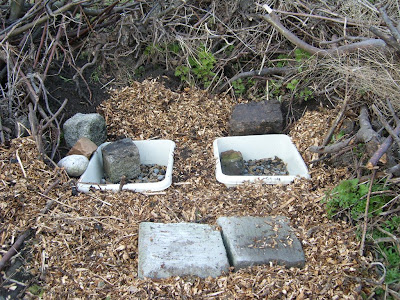
 There are flowers planted round the outside and on the outer edge of the wildlife corner the heap is framed by a some beautiful, fairly low informal copper beech bushes.
As you can see, there is no 'fence' at the front of this arrangement. I wonder if the Parks and Gardens department are going to insist that we have one. With two washing up bowl size mini-ponds? It would seem ridiculous to me. We're meeting them at 2.p.m. I'll keep you posted.
Saturday, 7 March 2009
International Womens' Day - More pics
 Here's a picture of the 'Make Gardens Not War' stall before the crowds started coming.
  A selection of wild flower seeds displayed by another stall holder.


 The Garden Organic Master Composters were in evidence too. There was a constant stream of people until three coming and viewing the Gaza film: 'Living without a bathroom' discussing the issues and taking leaflets. Lots of interest in Rod's blog, Joan's blog and the rest of the materials. The last picture is of a signing choir.
International Women's Day Part Two
 The time is 12.a.m. and I'm blogging from International Women's Day, sitting on the 'Make Gardens Not War' stall.
I'm listening to Christine Russell, M.P. for Chester making the introductory speech. So far she has mentioned the following issues: childcare, equal pay, part-time workers rights, maternity pay, flexible working hours for carers. She's also referred to the Millenium Development Goals. The fact that many women die in childbirth every year worldwide.
She's now finished. She has made no mention of the impact of war on women's lives globally. No mention of peace, no mention of food and water issues.
There are lots of people coming up to he stall to talk about Gaza, the film from Gaza I'm showing on my lap top and peace issues. Will report as the day goes on.
Tuesday, 3 March 2009
Digging for Food Democracy
The word 'politics' has shuffled it's way into my blog title bar. This was never going to be just-another-how-to-gardening blog. I don't see how you can produce your own food and just ignore the wider issues of availability, food politics and price.
So here's a bit of analysis. Tim Lang - President of 'Garden Organic' and his speech about 'Digging for Food Democracy'. For the 'thinking' gardener. He's the only professor of Food Policy we have in the U.K.
So here's a bit of analysis. Tim Lang - President of 'Garden Organic' and his speech about 'Digging for Food Democracy'. For the 'thinking' gardener. He's the only professor of Food Policy we have in the U.K.
Subscribe to:
Posts (Atom)