Showing posts with label carbon emissions. Show all posts

Friday, 17 September 2010

Canadian Tar Sands. Not the answer to Peak Oil.


Chief Al Lameman of the Cree First Nation (Centre)
with Chester Friends of the Earth and Greenpeace Delegation.
Odeon Cinema Manchester, England showing of "Tar Wars". Sept 17th.
Event organised by the Co-op Bank's Toxic Fuels Campaign.  
Left the allotment behind this week for the city and a big screen showing of "Tar Wars" - where hundreds of people came together to watch this BBC documentary - exposing the ecological and human damage caused by extensive tar sands exploration in Canada.

The message was: no matter how hard people try to take small steps in their everyday lives to cut carbon emissions - all our hard work could be thrown away by the multinationals.

Tar sands consist of oil trapped in a complex mixture of sand, water and clay. According to the Cooperative Bank - who are bank-rolling a huge campaign to stop the tar sands projects - the extraction and production of tar sands emits on average three times as much carbon dioxide as the extraction and production of conventional oil. Fully exploiting Canada's tar sands the co-op says "would lead to an estimated increase in atmospheric carbon dioxide of between 9 and 12 parts per million, enough to take us to the brink of runaway climate change". The oil industry is calling for $379 billion to be invested in the tar sands production by 2025 to massively increase production.

And there's a David for the Goliath oil corporations. At the film screening we had the privilege to meet Chief Al Lameman of the Cree First Nation. Around seventy per cent of all existing 'in-situ' operations are within Beaver Lake Cree traditional territories. Tar Sands exploration is set to triple within these territories over the coming years.

The Cree are mounting a legal challenge. Woodland Caribou are a symbol of Canada's pristine wilderness and an important part of traditional ways of hunting. They are found in undisturbed old growth boreal forest and forested peat lands. This small indigenous community are calling upon the Canadian government to protect the remaining ranges of the woodland caribou herds within their ancestral lands with immediate effect, including a moratorium on all new industrial developments. If this is not forthcoming they will seek a judicial review in the Canadian courts to force the Canadian Government to take this action.

All of these major new projects and expansion plans could be halted if the caribou herd ranges within the Beaver Lake Cree's ancestral lands were to receive legal protection. It would also prohibit a significant number of undeveloped leases granted in the southern Athabasca tar sands field.

Other speakers at the Manchester Meeting included: Jack Woodward, leading expert on Canadian aboriginal law and Beaver Lake Cree Counsel and Paul Monaghan, Head of Social Goals and Sustainability, The Co-operative.

To find out more about the campaign click here : Stop the Tar Sands - support the Beaver Cree Nation's Challenge

See also the feature : Fuelling the Future - Peak Oil what is it and why does it matter?
My article series on Sustainability, solar and the Triple Crunch.

Friends of the Earth on Tar Sands
Greenpeace campaign on Canadian Tar Sands

See this link to find out what the Canadian Government says about the "Oil Sands":
Canadian Government and Oil Sands.

For more pictures see this Guardian piece on the Tarnished Earth Exhibition - currently on London's South Bank.

Sunday, 12 April 2009

What to plant now

I'm determined not to miss any planting windows this year. So here is a run down of this week's plantings with photos. I've set up a growing system for myself, which I tweak occasionally. Work routines seem to help. So here's what our small courtyard looks like at the moment. Three mini-greenhouses plus a few tables and chairs to raise the pots up a little. We're into our second big phase of planting:

From left to right:
Little gem lettuces in a plug planter, started a month ago. Some of these I'll take to plant out today on the allotment and I'll put a few in the courtyard for the odd sandwich, and in case I can't make it down to the lottie during the week.
  1. Wild Rocket ready to plant out - this is a perennial plant so I'm hoping it will save me some work as I won't have to plant it out again every year.
  2. Large coir pots with Courgettes (3) to be planted out when they are large enough.
  3. Sweetcorn
  4. Balconi tomatoes - yellow and red
  5. Small pumpkins
  6. Lunch box cucumbers (long white paris)
  7. Globe Artichokes
  8. Two large pots of leeks to plant out in June.
  9. Melon
  10. Basil
  11. Pot of strawberries recovering from their journey through the post.
  12. Sugar snap peas
  13. Two tomatoes a bit further on
  14. Two pots of flowers
  15. Pot of calendula
  16. Tray of green and gold Orach

In this picture there's calabrese (started off a month ago). Coriander and lettuce seedlings (Lollo Rosso) to be planted out when they are big enough.
Oh, and broad beans in root trainers. They'll go out on the lottie in about ten days, I would think.

Close up of the lettuce seedlings. Best get on down to the lottie. Good weather waits for no man. (Or woman).

Tuesday, 24 March 2009

Living Simply

I've stopped thinking of myself as a virtuous person. I don't think I am. Every human being on this planet makes mistakes, becomes impatient, angry, emotional. I'm no saint - I'm a questioner.

I took my saint-less self along to the Quaker-led conference in Llandudno on the North Wales coast at the weekend with my family, (child and atheist other half). I'm going to write a few words about this, as I know that some Quakers are following this blog.

The weekend was called 'Living Simply'. It was a chance for people from Wirral, Chester and North Wales to explore what this might mean for them - in the context of peak oil/climate change and the rest of it. 'Living Simply' I felt, is just now, and has been for many years in fact, something that I do. For many years, a long time before I started talking directly to Quakers.

I discovered I don't want to imbue this thing (Living Simply) with all sorts of ideological meanings that I don't feel it should have. I feel it really puts people off. And I don't want to put people off, it's really important to save resources, cut your emissions and grow your own food.

I'm not vegetarian. We don't eat much meat. We don't have a car, we don't have a television (this astounds people - but please be assured - there is no shortage of information in our house!).

So, there were lots of joys at the weekend. Thank you everyone for organising it. I went to two work groups. One was called 'Combatting the Media'. The other I initiated - I called this 'Building Training for Organic Fruit and Vegetable Production'. The groups lasted 45 minutes each.

The 'Combatting the Media' group was particularly interesting for me. We talked about the 'red tops' - what sort of news hits the headlines and why. I tried to explain the sorts of challenges journalists are facing right now. Not a lot different I felt, from people in other industries hit by the recession with job cuts. Journos have a special place perhaps because (like teachers) people expect certain things of them. But like everyone else, they're fallible.

I talked a little bit, (in an individual capacity) about the NUJ campaign 'Journalism Matters'. That's a national campaign to protect quality journalism and it's vital role in our democracy. I painted a picture of what I thought would be a typical scenario:

Budget cuts in the newsroom - reporters wanting to cover particularly issues, but not getting the travel expenses or resources that they might need to do the best job they can. Not being able to travel to where the news is - to witness it yourself, but having to make do with telephone research. Needing to work faster and faster. Producing copy for print publications and with the Internet, producing web copy that's updated very fast, maybe more than once an hour. Having to multi-task. Not just writing, but photos too - using a video recorder...

I mentioned to the assembled company that the NUJ had an ethical code of conduct. Someone laughed. The expression on my face didn't change - I just took it as an indication of the ways in which quality journalism has been eroded. Maybe this started with Blair and his spin doctoring. Can we find our way back to something that consistently educates, informs and entertains without appealing to humanity's baser instincts? Our group scratched the surface of a discussion on the power of blogging, what blogs are, and what they can (and can't do).

Several insights came out of the organic food production group. We talked about Tim Lang, Garden Organic and the fact that only 5% of fruit is produced in the U.K. We collected and exchanged information about available training - in colleges of further education, at Garden Organic. There were some very experienced gardeners in the group and some newbies - so I hope during the course of the weekend that helped them get in touch with each other.

We talked raised beds and the pros and cons of them. Someone reminded me that railway sleepers are generally coated with preservative. One person did a presentation of the 'bag garden idea' which she said had come from South Africa, where land was in short supply. Put soil in a bag, (plastic or otherwise) and grow vegetables in it.

Allotments and the Allotment Act came up too. Shortages of them. We mentioned the allotments petition on the Wirral and someone said although the Allotment Act states that local authorities have to provide allotments if six people want them, there is no time scale attached to this, and so it is a blunt tool.

How to get round this, when people want land to grow vegetables on? If people have large gardens and they can't tend them, then you might be able to share with a neighbour. Check out the Landshare project.

As for the children - they got on with their bit. Building sandcastles on the beach.

Thursday, 19 March 2009

Spring fruit, vegetable, plant and flower inventory

Victoria Rhubarb. Two crowns planted last year. Peeping through their mulch.

Asparagus bed. Twelve Crowns. Planted as mini-plants in spring 2007. Can't remember which variety I planted, so I'll have to look it up, but that's another useful post perhaps...I've used modular raised beds fitted together to make a large unit and various kinds of mulches. Cocoa shells. Rabbit manure last year. Seems to be doing well. It's always slow to show itself in spring. Some say the mulch means the soil is slower to warm. A small trench at one edge and reclaimed fabric I found when I renovated the plot keeps the couch grass from the old path at bay.

Our favourite Autumn Gold raspberries ready to do their stuff. I'm going to wait for a good spot of rain and then mulch them again to keep the moisture in the soil.
Our lovely peach tree (Avalon Pride) made it through the frosts with buds (so far) intact. Compost heaps for perennial weeds directly behind it and on our half plot behind that we have onions, garlic (planted in autumn last year). Shallots planted a few weeks ago. First early Lady Christl potatoes went in last week. One bed on the half plot and two on the main plot. I haven't bothered watering these yet, that's my low maintenance approach, so hoping for some rain soon. Some broad beans under a cloche. Two comfrey beds in all. One on the half plot and one by the shed.
The large square structures on the right don't belong to us. Once the cherry plum bushes which frame the half plot come into leaf, I'm hoping you won't see them so much. I'll have to prune these cherry plums during the summer (they say if you do them in the winter there's a risk of silverleaf which is a fungal disease). There's a wild heap of rough twigs at either end of the full plot, good for ladybirds to overwinter and the occasional fox. I'm not going to remove this pile now until next autumn as spring is a busy time on the plot.

The smallish bed in front of the posh wooden compost heap is destined for Globe Artichokes, which are growing nicely in our mini-greenhouses at home. Blackcurrant bushes on the left, (you can't really see them yet as they've not come into leaf.

So that leaves the black plastic beds in the foreground, six of them if I remember rightly. I've just planted out some Chanteney carrots in the bed in the foreground. The blue pellets are organic slug pellets which I occasionally use for special things. Hoping I won't need these though, once the frogs are up and running! I'm chancing it a bit planting these out now, but there's a bit of a traffic jam at home with all the plug plants I'm raising, and since we've got serious kitchen gardening ambitions this year, there's no room for slackers!
Four more compost heaps. That's six heaps in total plus two huge 'wild' ones. An indication of the huge amounts of green waste we've composted so far on our plot. In three years we haven't burnt anything. We're not allowed to as far as I know.

This is the view I have when I sit on my deck chair in front of my shed. The plants on the left are lavender, majoram and sage. Majoram for pizza toppings. Sage for that wonderful sage and onion stuffing. And lavender for the bees. I'm so looking forward to seeing them again...

Monday, 9 February 2009

Using an urban hay box

I first saw a 'hay box' at least twenty five years ago at the Centre for Alternative Technologies in Machynlleth (in Wales). It was made of wood and polystyrene, I seem to remember. It didn't seem particularly practical.

But I have one now and have been using it regularly with success for the last two winters. As you can see it consists of two parts - both of which look a little bit like beanbags. We live in a city, and there is a distinct shortage of hay, so I guess this is the urban equivalent.

I bought this one from someone in New Zealand (it was very light to send through the post). They've stopped making them now, but if you are a dab hand with a sewing machine, you could construct one yourself and re-use the polystyrene beads that sometimes come with mail order items to fill the bags. It is basically two small bean bags.

There weren't any instructions with mine, and no recipes, so it was trial and error for me. I found it works very well with the lentil recipe featured in my last post. Anyone who has ever made a soup or stew will know that long, slow cooking is the order of the day. So using one saves a considerable amount of fuel (and carbon emissions).

Here's how:

1. Make up the recipe and heat it up really well. It works best with a large, heavy pan.

2. Place pan in hay box bean bag and put the top on. For additional insulation I put the whole hay box plus pan in a cardboard box - I also place a clean table cloth around the pan, so that if there is a spillage I can wash this instead of putting the whole bean bag hay box in the machine.

3. Leave it for three hours (or use it like an electric slow cooker and put it on in the morning for an evening meal) until the lentils are cooked. I don't cook meat dishes in my hay box, although I understand you can.

This is what the whole thing looks like with the top on:
And here's a link to the Centre for Alternative Technologies Shop. You can buy a leaflet for 50p which explains another way of making your own.

I'm really pleased that this blog now has readers from places as far afield as California, India, Poland and Australia. Welcome everyone! I'm sure that readers in these countries have different ways of using hay boxes. During the war here, people sometimes buried cooking vessels in the ground for cooking. Why not write in (use the comments box) and tell us all what your hay box looks like?

Wednesday, 28 January 2009

Cutting your carbon emissions

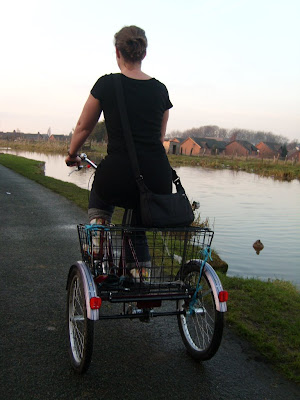
This blog's mission is to 'make organic gardening easier'. So I'd like to introduce you to my elegant eco-warrior Pashley tricycle. Made in Britain.

We don't have a car, so acquiring this stylish piece of kit cut my journey to the city allotment down by thirty minutes. Since I aim to visit the plot twice a week at least, that means I've saved myself at least two hours travelling time each week already.

We have a great local bike shop, and although there's too much traffic in our city, there is also a European funded towpath cycleway along the canal. As far as maintenance goes, the bike shop know me now. Very helpful. I walk in the door - they smile, point and say 'TRICYCLE' - so I don't even need to explain - an annual service costs around forty pounds. I'm not a bike geek so I don't know the technical term - but they put that green gunge in my tyres for me four months ago to stop the punctures and so far it has held up really well and I haven't had any at all. That's pretty good going when you consider the odd sharp bits you sometimes find on our allotment site paths.
Cost? £550 - it was on special offer, reduced by £100. I've seen them second hand too, though. Not cheap, but compared to the purchase and running costs of a car it measures up well. Keep the receipt safely. You might need it. Get it insured, and ask the police if they will post-code it for you. This gives you a certain amount of protection, as does a sign on the back saying 'this vehicle is post-coded' - basically means that if anyone decided to steal it, they would have a problem selling it on. Check with the police about this. They sometimes have public post coding sessions in shopping precincts and will engrave postcodes on the underside of your 'vehicle'.

As far as balance issues are concerned, it took me a little while to get used to riding it, it really is different from a bicycle. You have to lean the right way, but you'd soon get used to it. It does get heavy when it's fully loaded up (I can put half my potato harvest in the back), but if you get tired, just find a quiet spot and stay put and rest your legs for a minute. I've seen more expensive models with a motor that kicks in when you go up a hill. Might be useful. There's a sociable element to it too - people smile when they see it.

So, yes, carbon emissions. There are all sorts of controversies about these. I'm not vegetarian (yet). We eat a little, organic, locally sourced meat. I make it go a long way. Some people think that adopting a vegetarian diet is the best way of cutting down. For more thoughts on this check out my latest Helium article.

Here's another picture of my lovely trike - I'm just about to head off to the lottie.